
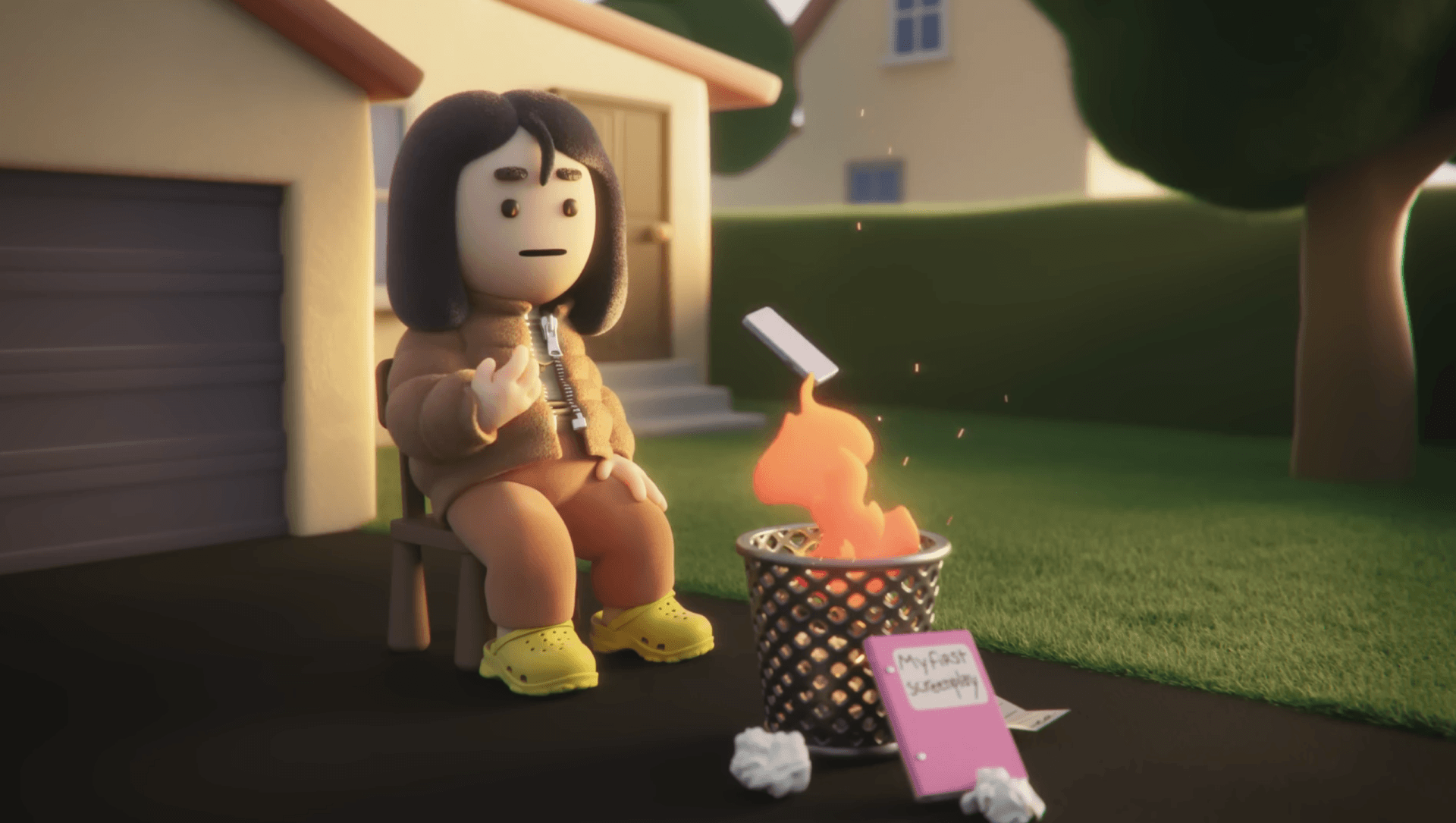
When self-care app Finch set out to create its first-ever brand campaign, the company wasn’t interested in the polished perfection often associated with wellness marketing. Instead, the creative team on the campaign embraced the strange, imperfect rituals that most of us can actually relate to.
The resulting campaign, “Whatever It Takes to Get Through the Day,” blends humor, honesty and impressive craft to celebrate the weird habits that help us get by.
The campaign is the first work Kevin Weir (Art Direction, 2012) has done through Weirwork, his just-launched independent creative venture, alongside collaborators PRETTYBIRD, Mathematic Studio, and Human. The project has been recognized for its distinctive voice and handcrafted approach— check out Ad Age‘s coverage on their site.
We caught up with Kevin to hear more about bringing the campaign to life, launching Weirwork and collaboration in advertising. Check out his Q+A below.
Congrats on launching Weirwork! What pushed you to start your own thing (and step away from traditional agency life) at this moment in your career?
Thank you! The whole thing sort of happened by accident. Through the process of working with Finch and creating their first brand campaign, I thought to myself, “this is actually pretty fun. I want to do more of this.” I guess that’s sometimes how agencies happen. Weirwork has the freedom/independence that I was hungry for when I was at a bigger agency, but it’s also made me realize that I still have some ambition beyond just freelancing (though I’m still doing some of that too).
Was Finch the first project for Weirwork? What made that opportunity the right fit?
Yeah, Finch approached me last year a little out of the blue, and I was pretty apprehensive at first. Freelance had been going really well and this sounded like a lot of responsibility/uncertainty. So I went in with the mentality that I had nothing to lose, and I was really honest to them about the kind of work I wanted to make and the kind of work that I thought would be good for them (which was a little different than their original brief). They really welcomed that thinking, and so they decided to bring me in. Those early conversations were super exciting because we were both doing a lot of learning and aligning with each other and it all felt really natural. My apprehension went away completely when I understood that they wanted to make something ambitious and subversive, and weren’t dead set on the ad sharing the exact tone as their app (which is quite sweet/genuine).
The campaign embraces the strange little things people do to get through the day. What was the insight that unlocked the idea for you and the team?
Early on, our strategist – Tom Naughton (Strategy, 2006), another VCU alum – brought us a thought which was essentially “it’s weird but it works.” This was originally just how we were thinking about the app, but we realized that it describes a lot of the things that we do for self-care. This lined up with some of the thinking from the client’s brief, around how they really wanted to show self-care for what it is (an imperfect thing that takes different forms for different people) and so the whole thing sort of clicked in from there and led to “whatever it takes to get through the day” as a celebratory anthem.
Can you talk a little about your role in the process as Creative Director?
This project was really fun because it flattened the entire agency structure into like three people (two creatives and a producer). It was kind of liberating. My partner on this one, Mark Bielik, and I were responsible for every facet of the project, from selling in the idea to running the production. We kept the clients super, super close through this whole process, so no need for super fancy decks or anything. Definitely not a traditional creative director role, with how hands on everything was. But there’s also the pressure of knowing that there’s no one else is checking your work or helping you make it better.

What was it like collaborating with Kirsten Lepore and the teams at PRETTYBIRD / Mathematics on the animation style and tone? Same for Composer Ava Matasavage and the Human team for music?
Kirsten was amazing. I’ve been a huge fan of her animation for a long time, so I was really excited that she was interested in the project. She ended up being super collaborative, super hands on, always took our ideas and made them even better. She had such a strong compass on the tone of the spot so we trusted her instincts every step of the way. Kirsten actually drew the original storyboards herself, which is pretty rare for a director on this type of project.
We had a big argument with Mathematic at one point because their (brilliant, talented) French animators were very opposed to us having a character wearing crocs. We got the feeling that French people really really hate crocs. That was probably the biggest disagreement. Everything else was very smooth and incredibly fun. I remember the first time we got a render preview for the opening scene and we were like “holy shit, this is going to look amazing.” They were great at taking Kirsten’s direction and bringing a lot of character through with subtle motions and details.
I’ve worked with Human on a number of projects, so there was a lot of trust going into the project. That being said, we were a little nervous about hearing demos because the song was so important and needed to be a true earworm. But they knocked it out of the park. We actually ended up using the very first demo from the first batch they sent us. We tried to beat it, but just kept coming back. We had some incredibly fun live sessions where we went in and played around with lyrics and performance and voices. Fun fact: I was the voice the kaiju monster in the film.
The campaign has such a bespoke, handcrafted feel (and obviously took many humans and hours to create.) Is that in response to the rapid rise and discussion around AI? What are your current thoughts on AI in the industry?
I don’t think it’s really a “response” to AI stuff. I guess it’s impossible to escape the context or the comparison, but truly we just wanted to make the best possible execution of the idea and that (I would say 100% of the time) is going to involve working with real musicians and animators. I think the Finch film has a lot of heart, which is kind of an intangible thing that you only get from a process that respects the audience, respects the brand, respects the production process.
I think that the absolute best, most rewarding part of being a creative in advertising (for me, anyway) is getting to rub shoulders with artists & production companies and make cool shit together. People who work in advertising are pretty cool, but we should not be left to our own devices. We need cooler, more interesting people to come in and bring new ideas and add a little bit of their own magic to our stuff. The work is a lot better for it, and in return, artists get the support they need to grow their careers and put stuff out into the world that inspires us. It’s a sacred alliance that I think we all benefit greatly from. That’s the world I prefer to work and live in.
What kinds of clients or projects are you hoping to attract with Weirwork?
Big ambition without big drama. In my experience, clients that are confident in their own instincts and aren’t ruled by fear are the best ones to work with. If there’s fear in the room, there’s never going to be room for fun. And I think that fun is genuinely one of the most important ingredients to effective work. Audiences can sniff out work that wasn’t fun to make.
From your time at Brandcenter, what top experiences or lessons have stayed with you over the years?
Your work being boring is the worst possible thing it can be. Whether it’s hanging up on the wall next to 20 other students, or airing on television next to 20 other ads. And the quality of your work is infinitely better when you’re having fun and not trying to force something. Also just generally, the process of being humbled is really important. Starting first year and realizing that you actually suck at everything. Then graduating and realizing that while you’ve come a long way, you still kind of suck and have a lot of learning to do. That learning never really stops.
What advice would you give current students?
Become obsessed with things that aren’t advertising. Film, music, games, birds, whatever. That’s the stuff that will make your work better, not other ads.
And have to ask – what’s one weird little thing that helps you get through the day?
I’m the guy in the film who sticks the cat in his face. I do that at least once a day.

Congrats to Kevin and team! Check out the full credits:
Creative: Weirwork
Executive Creative Director: Kevin Weir (Art Direction, 2012)
Creative Director: Mark Bielik
Producer: Isaac Hoff
Strategy Director: Tom Naughton (Strategy, 2006)
Production: PRETTYBIRD
Chief Executive Officer: Kerstin Emhoff
Animation Director: Kirsten Lepore
Executive Producer: Suzanne Hargrove
Head of Production: Rachel Main
Animation Producer: Martine Jean
Post Production / VFX: Mathematic Studio
CEO: Guillaume Marien
Executive Producers: Hadi Dahrouge, Christian Kelly
VFX Producer: Nikita Saini
VFX Supervisor: Manuel Quinto
VFX Coordinator: Guillaume Maire
Previz: Julien Missaire
Concept: Sylvain Sarrailh
Character: Jade Astoux, Clémence Perlin
Environment & Props: Alan Baugé, Lorine Guyard, Valentine Fripier, Orlane Brouillet, Élia Paoli, Lucas Benoit
Rig: Guillaume Boudeville, Jules-Baptiste Giraud
3D Animation: Christophe Mauceri, Charline Parisot, Emma Lebourgeois
Lighting: Anais Sassatelli, Manuel Quinto
Motion Design: Louise Pignier
FX: Paul Charpentier
Compositing: Eléonore Rolewski, Manuel Quinto Flame: Rime Murday
I/O: René Samoel
Studio Coordinator: Alexandra Brugalé Making-Of: Mathieu Keraudran
Music / Sound: Human
Composer: Ava Matasavage
Music Producer: Nicole Riolo
Creative Producer: Mike Jurasits
Managing Director: James Wells
Sound Engineer: Daryl Pinsdorf
Post Production: Rob Suchecki