
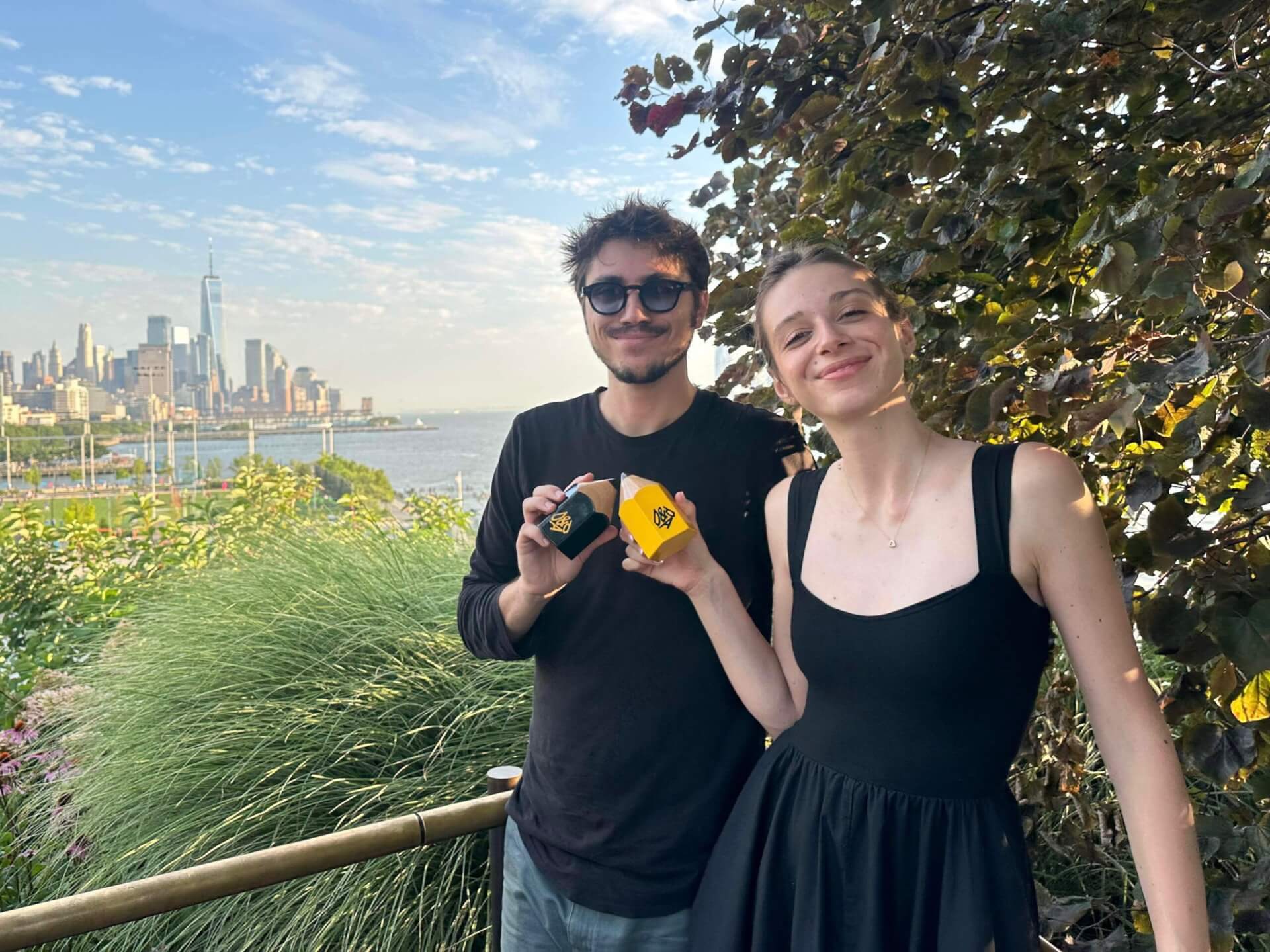
When Emma Kerencheva (Creative Brand Management, 2025) and Boyan Zlatarski (Copywriting, 2025) arrived in Richmond from Bulgaria to join the Brandcenter Class of 2025, they brought creative ambition and a fresh perspective. And they quickly discovered that having a different background wasn’t a disadvantage; it was their superpower.
“The need for ad school for us as internationals was very clear. It was hard to get a foot in the door of companies in the US or Europe, even with awards and experience,” said Zlatarski, a copywriter who worked at an agency in Bulgaria before coming to Brandcenter. He is now a Creative Fellow at Mother in NYC. “Brandcenter, with its connections, reputation, faculty, and alumni placement, was the perfect place to give us a headstart.”
Kerencheva, who completed the Creative Brand Management program and is now working as a Strategist at On Board Experiential in New York, recalls how the faculty stood out from the start. She recounts a conversation with Tom Scharpf (Art Direction, 1998), Chair of Art Direction: “Even the faculty were very active and personal in the recruitment process. They made sure to explain the curriculum and what life is like as a student.”
Looking through student portfolios sealed the deal. Zlatarski recalls scrolling through work from different schools. “And then we looked at Brandcenter portfolios. There were so many projects that made me go, ‘I wish I thought of that!’”
For both students, in addition to building better books, they found a place where their backgrounds were embraced. From day one, Zlatarski says he felt supported. Coming in as a foreigner with English as a second language, he was initially self-conscious. “I worried I might not be able to perform in the same way as native English speakers,” he said. “But people here helped me see my background and different perspective as a strength, something that could set me apart not just at school, but in the industry. I’m so grateful for that advice, because it dissolved all my initial worries and allowed me to focus on pushing the work.”

Kerencheva agrees, adding that being international gave them a creative edge. “Not being from here is actually a strength in advertising and at Brandcenter,” she explained. “You bring in different perceptions of brands and life experiences shaped by another culture, which adds valuable viewpoints to a team.” And while they contributed new perspectives, they were also eager to learn from their American classmates. “We learned a lot about Richmond and American culture just by being in a brainstorming room with our peers,” she said. “There’s this cultural education aspect of being an international student that allows you to pick up on insights that many people usually gloss over, and it’s also really fun.”
Their success has been undeniable. Together with classmates Alex Ward (Art Direction, 2025), Henry Coffey (Copywriting, 2025), and Callum Leitenberg (Copywriting, 2025), Kerencheva and Zlatarski became part of the first Brandcenter team to bring home a D&AD New Blood Black Pencil, the competition’s ultra-rare, highest honor for their work on a campaign for Adobe called “Scan to Revolt.” They made history again when the same team won a second Black Pencil this summer, making them the first team to win two black pencils, ever, in New Blood history. The award-winning guerilla marketing campaign “Ads for Rats” made waves in both trades and mainstream press, with features in outlets including Ad Age, USA Today, Yahoo!, and even a local NYC news station.
The team also received a Gold Pencil for Heinz: The 13th Egg at the Young Ones One Show, and Zlatarski won coveted Portfolio awards at both the Young Ones and New Blood competitions (see his website here).
For Zlatarski, his time at Brandcenter felt deeply collaborative and transformative. “The creative process at Brandcenter is two-way,” he said. “You and your ideas definitely have an impact on the school environment. Our success has created a whole wave of Brandcenter students proactively sending work to festivals in their first year. But, just as much, our taste and approach to work has been shaped by the brilliant classmates we were lucky enough to have in our cohort.”
That evolution happened not just in the classroom, but in the basement, team rooms, and long nights spent with classmates. He credits informal writing sessions with peers as crucial to his development. Joking about writing with teammates Coffey and Leitenberg, Zlatarski says, “Just doing homework together, trying to make each other laugh or push each other’s work, made me a monumentally better writer—and a monumentally faster one.”
That growth was also fueled by faculty who brought passion and clarity into lectures. “We’d often leave classes feeling like we could run through a proverbial wall of briefs,” he said. He gives particular credit to Tom Scharpf whose perspective on branding as a relationship of love and care between brand and consumer fundamentally changed the way Boyan sees the industry. “It helped me find purpose in the work,” he said. He also shouts out Ken Marcus for “somehow both giving us writers a thicker skin and reminding us not to take ourselves so seriously,” and Holly Hessler, Chair of Copywriting, “for encouraging us to dream big and think big.”
For Kerencheva, the transformation was just as real. “Your faculty and your team members push you to do things as if you were doing it in real life,” she said. “Even when we weren’t working on real clients, the level of research and detail we went into was beyond what people expect when you enter the industry.”
She credits her growth to the strategic rigor of her coursework and to faculty who helped her identify the unique value she brings to a team. “Before Brandcenter, I knew I wanted to work in the industry, but I had a vague idea of what I could contribute.” She thanks Jeremy Paredes (Creative Brand Management, 2011) for helping define the role of a brand manager, “I’m not a writer or designer, so the creative brand management track helped define the skills I bring to the room that help the process move forward.” she said.
She also acknowledges faculty members like Jess Collins (Strategy, 2010), KT Schaeffer (Art Direction, 2001) and Kevin Rothermel for developing her communication and presentation skills. “In Jess’s class, we’d rewrite briefs 20 or 30 times. That kind of repetition makes you better, it rewires your brain. You get more concise, clearer, and the ideas get sharper. It also teaches you how to give and receive feedback.”

And presenting became second nature over time. “When I started, I was terrified. My voice would shake. But you present so much, and faculty like KT, Jess, and Kevin teach you how to breathe, where to pause, how to hold a room. The difference between day one and the end is night and day. That kind of training has made me so much more confident at work.”
Still, the transition to life in the U.S. wasn’t without challenges. From navigating visas and scholarships to figuring out health insurance and where to find the best local food, being an international student meant learning a new culture inside and outside the classroom. But Kerencheva and Zlatarski said they never felt alone in that process.
“There were so many little things that made a big difference,” said Zlatarski. “People took the time to learn how to pronounce our names, to ask about Bulgaria, to help us settle in. We felt seen in every way.”
And it wasn’t just kindness, VCU offered structured international student resources. Brandcenter’s faculty and staff, including Associate Director Ashley Sommardahl (Strategy, 1998), offered personalized support. “Ashley connected me to alumni who were also international students,” said Kerencheva. “Hearing their stories helped me see what was possible.”
She adds, “Brandcenter is very, very international student friendly. There’s a community here. We’ve always had support from VCU as an institution for resources like choosing the right health insurance or finding health services through VCU.”
What they found in return was a place where ideas thrive, where late nights in Team Room 3 could turn into career-making projects, and where classmates became collaborators and lifelong friends. In the end, the cultural exchange went both ways. Emma and Boyan taught their peers about Bulgaria, shared traditional food, and brought fresh perspectives into every project.
Their advice to future international students?
Be bold. Be kind. Embrace where you’re from. And commit to the bit.
“For many international students, there’s no other option but for this to work,” said Zlatarski. “And when you show up with that mindset, you’re unstoppable.”